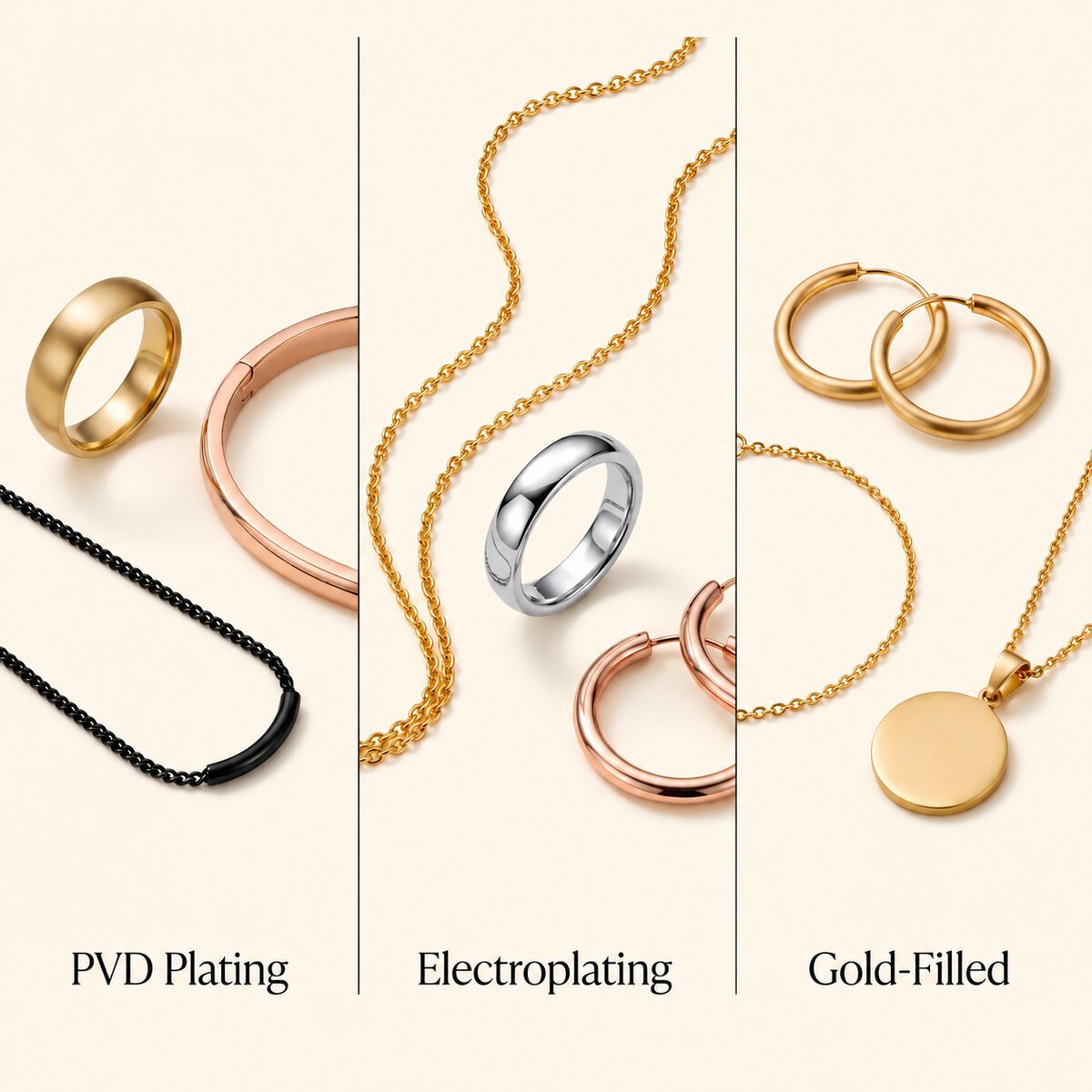
Surface finishing plays a major role in the appearance, durability, and perceived value of fashion jewelry. For B2B jewelry buyers, choosing the right finishing method is not only about color. It also affects cost, wear resistance, tarnish resistance, production feasibility, and customer satisfaction.
The most common surface color finishing methods for fashion jewelry include PVD plating, electroplating, and gold-filled construction. Each method works differently and is suitable for different base materials.
In general, PVD / IP plating is commonly used for stainless steel jewelry, electroplating, also called water plating, is widely used for sterling silver, brass, and copper jewelry, while gold-filled jewelry uses a mechanically bonded layer of karat gold over a base metal.
Understanding the difference between these three methods helps brands choose the right product specification for their market, price point, and durability expectations.
What Is PVD Plating for Jewelry?
PVD stands for Physical Vapor Deposition. In the jewelry industry, it is also commonly called IP plating, or ion plating. It is a vacuum-based coating process that deposits a very thin, hard color layer onto the jewelry surface.
PVD plating is especially popular for stainless steel jewelry because stainless steel has strong corrosion resistance, good hardness, and a clean surface that works well with vacuum coating.
For stainless steel jewelry, a typical PVD gold-color process is:
Titanium nitride layer / TiN base layer → gold or rose gold color layer
The TiN layer helps improve hardness, adhesion, and wear resistance, while the top color layer provides the final gold, rose gold, black, gunmetal, or other decorative finish.
Common PVD Plating Thickness for Stainless Steel Jewelry
For stainless steel fashion jewelry, common production standards include:
| Option | Structure | Application |
|---|---|---|
| Standard PVD thickness | 0.4 micron TiN + 0.05 micron gold color layer | Common jewelry factory standard |
| Thicker PVD option | 0.7 micron TiN + 0.1 micron gold color layer | Used when buyers request higher durability |
The exact thickness can vary depending on the factory, product design, color, and customer requirement. However, PVD jewelry coatings are usually measured in fractions of a micron, not several microns.
Common PVD Colors for Stainless Steel Jewelry
PVD is very versatile for stainless steel jewelry. Common color options include:
- 18K gold, one of the most popular commercial choices
- 14K gold
- 24K gold color
- Rose gold
- Black
- Gunmetal
- Coffee
- Blue
- Chromium color
- Multicolor or rainbow finish
White gold, silver, or rhodium colors can also be made on stainless steel jewelry, but it is important to clarify the process. If stainless steel jewelry is plated with rhodium, this is usually an electroplating / water plating process, not standard PVD.
Brass jewelry can also be made with PVD in some cases, but stainless steel remains one of the most common base materials for PVD fashion jewelry.
What Is Electroplating / Water Plating for Jewelry?
Electroplating, often called water plating in the fashion jewelry industry, is a liquid-bath plating process. It uses electric current to deposit a metal layer onto the jewelry surface.
Electroplating is widely used for:
-
Sterling silver jewelry
-
Brass jewelry
-
Copper jewelry
-
Some alloy jewelry
Unlike PVD, electroplating allows more flexible precious metal thickness options. It is commonly used for rhodium plating, gold plating, rose gold plating, silver plating, and other decorative finishes.
Electroplating for Sterling Silver and Brass Jewelry
For sterling silver and brass jewelry, the basic plating structure often includes a base preparation layer, a barrier layer, the final color layer, and sometimes a protective coating.
Brass or Copper Jewelry Plating Process
A common process for brass or copper jewelry is:
Base metal preparation → copper or nickel-free base layer → palladium barrier layer → rhodium / gold / rose gold plating → protective coating
For gold and rose gold brass jewelry, an additional protective layer such as e-coating, lacquer, or nano coating is often recommended to improve color retention.
Sterling Silver Jewelry Plating Process
A common process for sterling silver jewelry is:
Silver base preparation → polishing → palladium barrier layer → rhodium / gold / rose gold plating
Sterling silver is often plated with rhodium to create a bright white finish and reduce tarnishing. Gold plating can also be applied over sterling silver, depending on the buyer’s requirements.
Rhodium Plating for Sterling Silver and Brass Jewelry
Rhodium plating is commonly used for white-color jewelry. In the jewelry industry, it is sometimes casually described as “white gold plating” or “platinum color plating,” although rhodium and platinum are different metals.
For sterling silver jewelry, common rhodium plating options include:
| Option | Structure | Application |
|---|---|---|
| Standard rhodium plating | Silver base + 0.02 micron palladium + 0.03 micron rhodium | Common factory standard |
| Thicker rhodium plating | Silver base + 0.03 micron palladium + 0.05 micron rhodium | Higher requirement option |
| Extra-thick rhodium plating | Silver base + 0.05 micron palladium + 0.09–0.1 micron rhodium | Premium option, higher cost |
For brass jewelry in white color, rhodium plating is often preferred over platinum-color plating when buyers require better brightness and a more premium white finish.
Gold Electroplating for Sterling Silver and Brass Jewelry
Gold electroplating is one of the most common finishing methods for sterling silver and brass jewelry. It can be used to create 18K gold, 14K gold, rose gold, or other gold-tone finishes.
Typical gold plating structures include:
| Option | Structure | Application |
|---|---|---|
| Standard gold plating | 0.02–0.04 micron palladium + 0.03 micron 18K gold | Common factory standard |
| Thick gold plating | 0.05 micron palladium + 3 micron 18K gold | Available for buyer-specific requirements |
| Custom gold thickness | 18K gold plating in customized thickness | Based on buyer request, such as 3–5 microns, 5–8 microns, or higher |
For brass and copper jewelry, the gold layer is important, but the outer protective coating is also critical. A thicker gold layer does not automatically guarantee longer color retention if the surface protection, polishing, and plating quality are poor.
For gold and rose gold brass jewelry, e-coating or lacquer protection can significantly improve wear performance and color life. However, e-coating may not be suitable for all designs, especially sandblasted surfaces, because it can create a slightly hazy or plastic-like finish.
Silver Plating for Sterling Silver Jewelry
Sterling silver jewelry can also be plated with fine silver, commonly 999 silver, to create a brighter silver-white appearance.
Common silver plating options include:
| Option | Structure | Application |
|---|---|---|
| Standard silver plating | 999 silver, 3–5 microns | Common factory standard |
| Custom thick silver plating | 999 silver, 5–10 microns or more | Based on buyer requirement |
Silver plating thickness can be customized according to the buyer’s market positioning and cost target.
What Is Gold-Filled Jewelry?
Gold-filled jewelry is different from both PVD plating and electroplating.
Gold-filled jewelry is made by mechanically bonding a layer of karat gold to a base metal, usually brass, through heat and pressure. The gold layer is much thicker than standard electroplated gold, and the material is often used for chains, wire, findings, hoops, and minimalist jewelry styles.
In the U.S. market, “gold filled” has a recognized jewelry-marking meaning. The FTC Jewelry Guides describe standards for jewelry product claims, and industry references commonly explain gold-filled items as having a mechanically bonded gold layer that is at least 1/20 of the total metal weight and at least 10K gold when marked as gold filled. (Electronic Federal Register)
For example, a common marking is:
1/20 14K GF
This means that 1/20 of the total metal weight is 14K gold.
French Plaqué Or vs Gold-Filled Jewelry
When discussing gold-filled jewelry with European buyers, it is important to understand that the terminology may not be used in exactly the same way as in the U.S. market.
In the United States, “gold filled” is commonly understood as a mechanically bonded gold layer over a base metal, often marked as 1/20 14K GF or similar. This marking focuses on the gold weight ratio and the karat quality of the bonded gold layer.
In Europe, however, there is no single EU-wide “gold filled” definition that works exactly the same way as the U.S. system. Different European countries may use different legal and commercial terms for gold-covered jewelry, such as gold plated, rolled gold, bonded gold, vermeil, or the French term Plaqué Or.
French Plaqué Or: A Useful Example for European Buyers
France is a good example because the term Plaqué Or has a more specific meaning in the jewelry market. In French jewelry terminology, Plaqué Or generally refers to a base metal, often brass or copper, covered with a layer of gold that is thick enough to meet the local standard for gold-plated jewelry.
A common French-style high-quality specification is 18K gold plating over brass or copper with a 3-micron gold layer. In this case, “18K” refers to the gold quality of the outer layer, while the core material remains a non-precious base metal.
This type of construction allows brands to create fashionable, detailed, and cost-effective jewelry designs while still offering a richer gold appearance than very thin flash-plated jewelry. It is often used for earrings, rings, necklaces, bracelets, and other fashion jewelry styles that require a premium gold look at a more accessible price than solid gold.
Plaqué Or Is Not the Same as U.S. Gold Filled
Although French Plaqué Or and U.S. gold-filled jewelry are both positioned above standard low-cost gold plating, they are not the same process.
Gold-filled jewelry is made by mechanically bonding a layer of karat gold to a base metal core. The value is usually described by the gold weight ratio, such as 1/20 14K GF.
French Plaqué Or, on the other hand, is usually discussed by the gold layer thickness, such as 3 microns, and by the gold fineness of the outer layer, such as 18K or 750/1000 gold.
For this reason, if a product is made with 18K gold plating over brass at 3 microns, it is more accurate to describe it as 18K gold-plated brass, 3 microns, or French-style Plaqué Or specification, rather than calling it U.S.-style gold filled.
Why French-Style 18K Plaqué Or Is Popular
French-style 18K Plaqué Or is popular because it offers a strong balance between design flexibility, appearance, and cost. Since the core material is usually brass or copper, the jewelry can be made into many shapes, including delicate pavé styles, polished statement pieces, and larger fashion designs.
The outer 18K gold layer gives the jewelry a warmer and more refined gold tone, closer to the appearance of real 18K gold than many ordinary gold-tone finishes. With proper polishing, plating control, and care, this type of jewelry can provide a more premium look and better color retention than very thin flash plating.
However, buyers should understand that Plaqué Or is still not solid gold. Its durability depends on the gold thickness, base metal quality, polishing, surface preparation, protective finishing, and how the jewelry is worn and maintained.
Vermeil in the European and French Context
For sterling silver jewelry, European buyers may also ask about vermeil. Vermeil is different from brass-based gold plating because the base metal is silver.
In the French context, vermeil generally refers to sterling silver jewelry covered with a sufficiently thick gold layer. This makes it a premium option for buyers who want a precious metal base with a gold appearance.
For B2B buyers, the key distinction is simple: gold-filled jewelry is based on a mechanically bonded gold layer, Plaqué Or is usually a gold-plated base metal structure, and vermeil is gold over sterling silver.
Gold-Filled vs Gold-Plated Jewelry
Gold-filled jewelry is often chosen by brands that want better durability than standard gold plating, but at a more accessible price than solid gold.
The key difference is the way the gold layer is applied.
Gold plating uses an electrochemical process to deposit a thin layer of gold onto the surface. Gold-filled material uses a much thicker karat gold layer that is mechanically bonded to the base metal.
Because of this, gold-filled jewelry generally has better wear resistance and longer color life than standard gold-plated brass jewelry. However, it also has design and manufacturing limitations.
Gold-filled material is often supplied as sheet, wire, tube, or chain. It is suitable for many classic jewelry styles, but it may not be ideal for all complex cast designs, deeply textured surfaces, or products that require full-color finishing after casting.
Pros and Cons of Gold-Filled Jewelry
Gold-filled jewelry is a strong option for brands that want a premium gold look with better durability than standard plating.
Advantages
Gold-filled jewelry has a thicker gold layer than standard electroplated jewelry. It offers better long-term color retention, stronger perceived value, and is popular in the U.S. market for demi-fine and premium fashion jewelry.
It is also a good choice for products such as hoop earrings, chains, bracelets, wire-wrapped styles, and minimalist pieces.
Limitations
Gold-filled jewelry is more expensive than standard gold-plated brass jewelry. It also has more restrictions in product development because the material is often pre-bonded before the jewelry is formed.
For highly detailed cast designs, complex 3D shapes, or styles that require multiple polishing and soldering steps, gold-filled construction may not be the best option. In those cases, sterling silver with gold plating, brass with thick gold plating, or stainless steel with PVD may be more suitable.
PVD vs Electroplating vs Gold-Filled
| Feature | PVD / IP Plating | Electroplating / Water Plating | Gold Filled |
|---|---|---|---|
| Common base material | Stainless steel | Sterling silver, brass, copper | Brass core, sometimes other base metals |
| Process | Vacuum coating | Liquid-bath metal deposition | Mechanical bonding of karat gold layer |
| Typical gold thickness | Very thin, often below 0.1 micron for color layer | Flexible, from flash plating to several microns | Based on gold weight ratio, not simple micron thickness |
| Durability | Very good on stainless steel | Depends on thickness, process, and protective coating | Better than standard gold plating |
| Cost | Moderate to high depending on color and thickness | Flexible from low to high | Higher than standard plating |
| Color options | Gold, rose gold, black, gunmetal, blue, rainbow, etc. | Rhodium, gold, rose gold, silver, etc. | Mainly karat gold colors |
| Best for | Stainless steel jewelry | Sterling silver and brass jewelry | Premium fashion and demi-fine jewelry |
| Main advantage | Hard, wear-resistant, modern finish | Flexible thickness and color options | Thicker gold layer and stronger market appeal |
| Main limitation | Not suitable for very thick gold layers like 3 microns | Color retention depends on plating quality and protection | Limited design flexibility and higher material cost |
How to Choose the Right Jewelry Surface Finish
The best finishing method depends on the base material, target price, customer expectation, and product design.
For stainless steel jewelry, PVD / IP plating is usually the best choice. It offers good wear resistance, a clean finish, and a wide range of modern colors. However, it is not the right process if the buyer requires a true 3-micron gold layer.
For sterling silver jewelry, rhodium plating is ideal for bright white color and tarnish resistance. Gold plating can also be applied, and thicker gold plating can be customized for higher-end requirements.
For brass and copper jewelry, electroplating is the most flexible option. Gold, rose gold, rhodium, and silver colors can all be made. For better color retention, especially on gold and rose gold finishes, an additional e-coating, lacquer, or nano protective layer is recommended.
For premium gold-color jewelry, gold-filled construction is a strong option. It is especially suitable for brands targeting the U.S. market with better durability than standard gold-plated jewelry, while still keeping the price below solid gold.
Best Finish for Each Jewelry Material
There is no single best surface finishing method for all fashion jewelry. The right choice depends on the material and the buyer’s quality standard.
Use PVD plating for stainless steel jewelry when you need a durable, modern, wear-resistant finish.
Use electroplating for sterling silver, brass, and copper jewelry when you need flexible color options and customizable thickness.
Use gold-filled jewelry when you need a thicker karat gold layer, stronger perceived value, and better durability than standard gold plating.
For professional jewelry sourcing, buyers should always confirm the base material, plating structure, plating thickness, protective coating, color standard, and testing requirements before placing bulk orders. This helps ensure that the final product meets both brand expectations and market requirements.
FAQs
Is PVD plating better than electroplating?
PVD plating is usually better for stainless steel jewelry because it creates a hard, wear-resistant surface. Electroplating is better for sterling silver, brass, and copper jewelry when buyers need flexible precious metal thickness and color options.
Can stainless steel PVD plating be made to 3 microns?
Usually, no. In fashion jewelry production, stainless steel PVD plating is normally a thin, hard, and dense coating, not a thick precious metal layer.
Making PVD as thick as 3 microns would require much longer production time and higher cost. It may also cause issues such as uneven color, internal stress, poor edge coverage, or weaker adhesion.Stainless steel PVD specification such as 0.4 micron TiN + 0.05 micron gold layer or 0.7 micron TiN + 0.1 micron gold layer is much more common than 3 microns.
If you need a true 3-micron gold layer, gold electroplating, vermeil, or gold-filled jewelry may be a better choice.
What is the best plating for sterling silver jewelry?
For white sterling silver jewelry, rhodium plating is one of the most common choices because it provides a bright white finish and helps reduce tarnishing. For gold-color sterling silver jewelry, gold plating or gold vermeil can be used depending on the required thickness and market positioning.
What is the best plating for brass jewelry?
Brass jewelry is commonly finished with gold plating, rose gold plating, rhodium plating, or silver plating. For better color retention, gold and rose gold brass jewelry should often include e-coating, lacquer, or nano protection.
Is gold-filled jewelry the same as gold-plated jewelry?
No. Gold-filled jewelry is made by mechanically bonding a thick layer of karat gold to a base metal core, usually brass. Gold-plated jewelry uses an electroplating process to deposit a thinner gold layer onto the surface. Gold-filled jewelry is generally more durable than standard gold-plated jewelry.
Which jewelry finish is best for a premium fashion jewelry brand?
For stainless steel jewelry, PVD plating is a strong premium option. For sterling silver jewelry, rhodium plating, thick gold plating, or gold vermeil can be used. For gold-color brass-based jewelry, gold-filled construction is a premium alternative to standard gold plating.
Need Help Choosing the Right Jewelry Surface Finish?
Choosing the right surface finishing method can improve product quality, reduce after-sales issues, and help your jewelry collection match your target market.
Whether you are developing stainless steel PVD jewelry, sterling silver rhodium-plated jewelry, brass gold-plated jewelry, or gold-filled jewelry, our team can help you evaluate the right material, plating thickness, color option, and production solution for your brand.